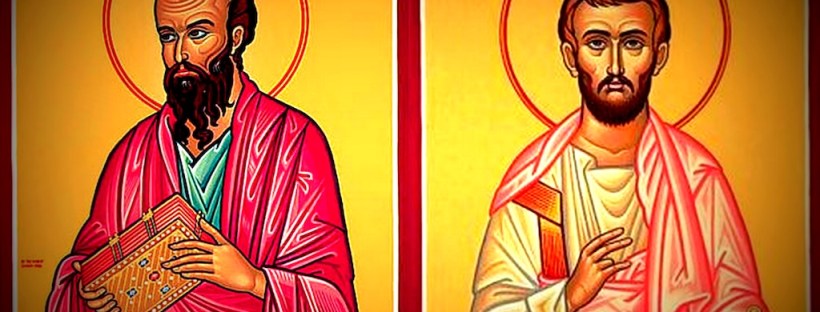
One of the major debates in Christianity is justification – specifically, whether we are justified by faith alone or faith plus works. Proponents of the “faith alone” position will often cite Paul’s epistles to support their arguments, particularly Romans, while the “faith plus works” crowd will often cite James’ epistle to support theirs. I’ll provide a sample below from each epistle to demonstrate the tension.
What then shall we say was gained by Abraham, our forefather according to the flesh? For if Abraham was justified by works, he has something to boast about, but not before God. For what does the Scripture say? “Abraham believed God, and it was counted to him as righteousness.” Now to the one who works, his wages are not counted as a gift but as his due. And to the one who does not work but believes in him who justifies the ungodly, his faith is counted as righteousness. Rom 4:1-5
Was not Abraham our father justified by works when he offered up his son Isaac on the altar? You see that faith was active along with his works, and faith was completed by his works; and the Scripture was fulfilled that says, “Abraham believed God, and it was counted to him as righteousness”—and he was called a friend of God. You see that a person is justified by works and not by faith alone. James 2:21-24
To the casual observer, the above passages would indicate that James and Paul are contradicting each other, and this is something you’ll often hear alleged by critics of Christianity. Paul is arguing that faith apart from works saves us, while James states that faith without works cannot justify.
But I would argue that upon closer inspection, there is no contradiction here. To demonstrate that, I’m going to provide more passages of Scripture where Paul speaks of salvation by grace through faith, with what I think is enough context provided to get his intended message across.
But God, who is rich in mercy, because of His great love with which He loved us, even when we were dead in trespasses, made us alive together with Christ (by grace you have been saved), and raised us up together, and made us sit together in the heavenly places in Christ Jesus, that in the ages to come He might show the exceeding riches of His grace in His kindness toward us in Christ Jesus. For by grace you have been saved through faith, and that not of yourselves; it is the gift of God, not of works, lest anyone should boast. For we are His workmanship, created in Christ Jesus for good works, which God prepared beforehand that we should walk in them. – Ephesians 2:4-10
But whatever was gain to me I count as loss for the sake of Christ. More than that, I count all things as loss compared to the surpassing excellence of knowing Christ Jesus my Lord, for whom I have lost all things. I consider them rubbish, that I may gain Christ and be found in Him, not having my own righteousness from the law, but that which is through faith in Christ, the righteousness from God on the basis of faith. – Philippians 3:7-9
So from now on we regard no one according to the flesh. Although we once regarded Christ in this way, we do so no longer. Therefore if anyone is in Christ, he is a new creation. The old has passed away. Behold, the new has come! All this is from God, who reconciled us to Himself through Christ and gave us the ministry of reconciliation: that God was reconciling the world to Himself in Christ, not counting men’s trespasses against them. And He has committed to us the message of reconciliation. – 2 Corinthians 5:16-19
I want to draw special attention to how Paul defines saving faith in these passages. Faith in Christ to Paul isn’t, as some would argue, a mere mental checklist of things we agree with that somehow make us fit for heaven. Rather, it’s a fixed trust in the finished work of Christ that makes us an entirely new creation, all because of the grace of God. Notice how in Philippians 3 Paul tells us that our righteousness is not from the law but through faith in Christ – implying that Christians should live lives marked by good works. But even the good lives we live are not our own doing, it’s entirely because of God’s grace.
The same basic idea is articulated in Ephesians 2:10 where, after Paul says we are saved by grace and not works, he states that God has prepared for us to do good works in Christ. But this comes as a result of us being “His workmanship”, showing that even the good works we do as a result of our faith aren’t our own doing, but entirely God working in us.
Now, let’s revisit James. This time, I’ll provide greater context, and show the entirety of James 2 that talks about faith without works being dead.
What good is it, my brothers, if someone claims to have faith, but has no deeds? Can such faith save him? Suppose a brother or sister is without clothes and daily food. If one of you tells him, “Go in peace; stay warm and well fed,” but does not provide for his physical needs, what good is that? So too, faith by itself, if it does not result in action, is dead.But someone will say, “You have faith and I have deeds.” Show me your faith without deeds, and I will show you my faith by my deeds. You believe that God is one. Good for you! Even the demons believe that—and shudder.O foolish man, do you want evidence that faith without deeds is worthless?Was not our father Abraham justified by what he did when he offered his son Isaac on the altar? You see that his faith was working with his actions, and his faith was perfected by what he did. And the Scripture was fulfilled that says, “Abraham believed God, and it was credited to him as righteousness,”and he was called a friend of God. As you can see, a man is justified by his deeds and not by faith alone.In the same way, was not even Rahab the prostitute justified by her actions when she welcomed the spies and sent them off on another route? As the body without the spirit is dead, so faith without deeds is dead. – James 2:14-26
James is talking about an entirely different faith from Paul. A faith that doesn’t produce any fruit, that doesn’t make you a new creation, and that doesn’t give you any sort of righteousness. Notice in the beginning how James writes about someone “claiming to have faith”, not that they have it to begin with.
But more than that, verse 19 is the key to understanding what James is talking about. And it’s this verse more than any other that shows there is zero contradiction between him and Paul:
“You believe that God is one. Good for you! Even the demons believe that – and shudder.” – James 2:19
There you have it.
James isn’t talking about faith in Jesus Christ. He’s talking about generic faith in there being one God (or God being one, as this translation puts it) that doesn’t involve any trust in Jesus Christ or His finished work on the cross. The demons believe in God, and they believe in Jesus as a personal entity. In fact, they could probably articulate a better doctrine of the Trinity than anyone on Earth could, since they served the Triune God before the fall.
But they don’t believe that Jesus Christ died for their sins. They aren’t trusting in Christ as their Savior. And that is the difference between saving faith, and a dead faith.
Conclusion.
There is no contradiction between James and Paul on the issue of soteriology. Paul would not have any issue with James’ epistle, and James wouldn’t with Paul’s, because they’re not talking about the same type of faith. When Paul speaks of faith saving us apart from works, he’s talking about faith in Jesus Christ and His finished work at the cross. This faith makes us an entirely new creation with a new heart that spurs us to good works, entirely due to the grace of God. But James is referring to a generic, monotheistic faith that doesn’t involve any of this.
 The Armchair Apologist