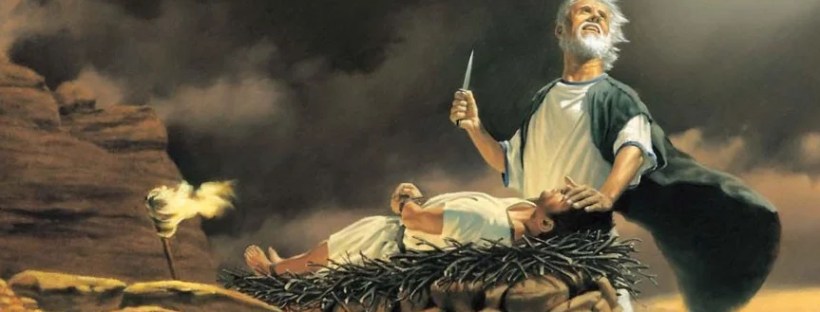
Ah yes, that one controversial bible story

Probably the most controversial story in the entire Bible is God ordering Abraham to kill his firstborn son, Isaac. This story, recounted in Genesis 22, tells us that God commanded Abraham to offer Isaac as a burnt offering on a mountain of His choosing. When Abraham brought Isaac with him on the mountain, he bound Isaac to the table, but just as he raised the knife to kill him, the angel of the Lord called down and told Abraham to stop what he was doing. Abraham then notices a ram in the thickets and, recognizing it as God’s providence, offers the ram as a sacrifice on the altar instead of Isaac.

 On the third day Abraham lifted up his eyes and saw the place from afar.  Then Abraham said to his young men, “Stay here with the donkey; I and the boy will go over there and worship and come again to you.”  And Abraham took the wood of the burnt offering and laid it on Isaac his son. And he took in his hand the fire and the knife. So they went both of them together. And Isaac said to his father Abraham, “My father!” And he said, “Here I am, my son.” He said, “Behold, the fire and the wood, but where is the lamb for a burnt offering?” Abraham said, “God will provide for himself the lamb for a burnt offering, my son.” So they went both of them together.

 When they came to the place of which God had told him, Abraham built the altar there and laid the wood in order and bound Isaac his son and laid him on the altar, on top of the wood. Then Abraham reached out his hand and took the knife to slaughter his son.  But the angel of the LORD called to him from heaven and said, “Abraham, Abraham!” And he said, “Here I am.”  He said, “Do not lay your hand on the boy or do anything to him, for now I know that you fear God, seeing you have not withheld your son, your only son, from me.” And Abraham lifted up his eyes and looked, and behold, behind him was a ram, caught in a thicket by his horns. And Abraham went and took the ram and offered it up as a burnt offering instead of his son.  So Abraham called the name of that place, “The LORD will provide”; as it is said to this day, “On the mount of the LORD it shall be provided.” – Genesis 22:4-14

Criticisms abound with this story and how it portrays God’s character, with some labelling it a “diabolical request” that puts a blameless victim in a horrific moral conflict. Others also argue that it paints Abraham in a horrible light as well, as a “morally insensitive servant” who was willing to kill his son without a second thought. Some biblical scholars also argue that this passage contradicts God’s later opposition to child sacrifice, as mentioned here.

I’d be lying if I said I didn’t understand the criticisms. Even though the story did end with God stopping Abraham from sacrificing Isaac, just the fact that He commanded Abraham to do it at all is something many people wrestle with, including millions of Christians. This isn’t something we as believers can just gloss over. 

That being said, I also want to provide a different perspective than a lot of Christians have given in response to criticism levied against this story. Many have argued that this story demonstrates how we ought to put God above all else, even family. That our love for God should eclipse all else in our lives. While I certainly agree with that sentiment, and it’s definitely scriptural (Deuteronomy 6:5, Matthew 10:37, Matthew 19:29), I don’t think that’s the point of Genesis 22. In fact, I think it does more harm than good to look at the story that way. 

Instead, we need to look at Genesis 22 in its full context – not just the context of the chapter itself (especially considering that “chapters” weren’t really in the minds of the authors who wrote the books of the Bible) but of Abrahams story leading up to this point. Abraham was promised the entire land of Canaan in Genesis 12:1-2: 

The Lord had said to Abram, “Go from your country, your people and your father’s household to the land I will show you.

“I will make you into a great nation,
    and I will bless you;
I will make your name great,
    and you will be a blessing.

This promise is reiterated in Genesis 15:5, where God tells Abraham that his offspring will be as numerous as the stars in the sky, and “counts it as righteousness” when Abraham simply believes the promise despite his old age and lack of children. Of Isaac specifically, God says in Genesis 17:16 and 19 that he will be made into a great nation, whose lineage will include kings. And if Genesis 15:6 is anything to go by, Abraham surely believed this – after all, if he could believe BEFORE he became a father, it must have been much easier to believe after the fact!

Why am I pointing all of this out, though? Because it gives us a crucial bit of context that paints Abrahams actions in Genesis 22 in a new light. Context that is even provided millenia later, in Hebrews 11:18-19:

God had said, “The descendants I promised you will be from Isaac.” Abraham believed that God could raise the dead, and really, it was as if Abraham got Isaac back from death.

“It was as if Abraham got Isaac back from death.”

Abraham had enough faith to know that the same God that made a covenant with him to provide as many descendants as the stars in the sky, could bring his son back to life. And indeed, Abraham had no reason not to believe God would do this, since God told him that this promise would come through Isaac. Awfully hard for your lineage to include kings, if you’re dead before you have a son of your own!

Abraham understood this, and understood that even if God commanded him to kill Isaac, that he wouldn’t be separated from his son for too long. Abraham knew that one way or another, Isaacs death would be far from permanent, that God would deliver him from the clutches of death. That, in my humble opinion, is the test that Abraham had to pass by laying his son on the altar. It was never a question of, “You must be willing to kill your son to show that you love me more.” (Far be it from God to test anyone in such a way, especially since He explicitly forbids child sacrifice!) Rather, the test was, “Do you have enough faith to believe that I can raise your child from the dead? That everything I’ve promised you will come true, even if it looks like you will be preventing it?”

But more than that – this story is, as many stories in the Old Testament are, a type and shadow of Jesus Christ himself. Think about it? A father who willingly sacrifices his own son, knowing that his son will be raised from the dead? The only difference, of course, is that unlike with Abraham, God the Father did not spare Himself the pain of having his own Son taste death. If only temporarily. He intervened and provided a ram instead.

Conclusion

Genesis 22 is difficult to swallow for many people, believers included, and with good reason. It’s not an easy thing to read about sacrifice or even potential sacrifice of your own child to any god you may or may not believe in. But as I’ve said in my post Addressing Three Atheist Arguments, the focal point of the Christian religion is that death is not the end. It is not a roadblock to our life, merely a change of location, one that is not at all permanent from God the Father’s point of view. And with all that considered, I submit to you that this story does not, in fact, paint God as a monster.

The Contradiction of Mormonism

The Mormon church has experienced quite a bit of growth over the past several years, and with that growth has come the birth (or perhaps rebirth) of LDS apologetics and online influencers. This has sparked major debates between Mormons and members of other faiths or no faith at all. It has also sparked the creation of major online accounts on Youtube and other platforms critiquing the Mormon church by ex-members. Most importantly, from my perspective, it’s sparked intense debate between Latter Day saints and members of mainstream Christian denominations. One of these debates is a particularly fascinating dialogue between Gavin Ortlund and Jacob Hansen on the Trinity, if you’re interested feel free to check it out HERE.

Today though I wanted to give my perspective on the Mormon religion and why I don’t believe in it, nor consider it a genuine expression of the Christian faith. Growing up I was told by other Christians that they believed a lot of crazy things like having a bunch of kids is necessary so that “alien spirits” can possess them. Having studied Mormonism more thoroughly I’ve shed a lot of the misconceptions, but my main reason for rejecting it is their stance on the Trinity. 

To put it simply, Mormons don’t believe in the Trinity. They believe that God the Father, Jesus Christ and the Holy Spirit are part of the “Godhead”, meaning that they share the same doctrine and purpose, but they are not one in nature. The Trinity teaches that the Father, Son and Holy Spirit are indeed three distinct persons but also sharing one indivisible divine nature. Unpacking the doctrine of the Trinity and explaining why it’s an orthodox Christian belief however requires a separate post, so I’ll save that for another time. 

Back to the Mormon view of the Godhead, their interpretation of the Father, Son and Holy Spirit’s relationship I think is demonstrated clearly in these quotes from various elders: 

Latter-day Saints pray to God the Father in the name of Jesus Christ. They acknowledge the Father as the ultimate object of their worship, the Son as Lord and Redeemer, and the Holy Spirit as the messenger and revealer of the Father and the Son. But where Latter-day Saints differ from other Christian religions is in their belief that God and Jesus Christ are glorified, physical beings and that each member of the Godhead is a separate being. The true doctrine of the Godhead was lost in the apostasy that followed the Savior’s mortal ministry and the deaths of His Apostles.- churchofjesuschrist.org., “Godhead.”

“We do not believe in what the Christian world calls the doctrine of the Holy Trinity. In his First Vision, Joseph Smith saw two distinct personages, two beings, thus clarifying that the then-prevailing beliefs concerning God and the Godhead were not true…We know that the three members of the Godhead are separate and distinct beings. We know this from instruction given by the Prophet Joseph Smith: “The Father has a body of flesh and bones as tangible as man’s; the Son also; but the Holy Ghost has not a body of flesh and bones, but is a personage of Spirit.” – Dallin H. Oaks, “The Godhead and the Plan of Salvation.”

“We declare it is self-evident from the scriptures that the Father, the Son, and the Holy Ghost are separate persons, three divine beings, noting such unequivocal illustrations as the Savior’s great Intercessory Prayer just mentioned, His baptism at the hands of John, the experience on the Mount of Transfiguration, and the martyrdom of Stephen—to name just four.” – Jeffrey R Holland, “The Only True God And Jesus Christ Whom He Hath Sent.”

Contrary to the doctrine of the Trinity, the Mormon church confesses that the Father, Son, and Holy Spirit are completely separate beings that don’t share the same divine substance. Scripture though paints a much different picture, starting at the very first chapter of Genesis: 

“Then God said, “Let us make mankind in our image, in our likeness, so that they may rule over the fish in the sea and the birds in the sky, over the livestock and all the wild animals,[a] and over all the creatures that move along the ground. So God created mankind in his own image in the image of God he created them; male and female he created them.” – Genesis 1:26-27

“I and the Father are one.” – John 10:30.

For there are three that bear witness in heaven: the Father, the Word, and the Holy Spirit; and these three are one.” – 1 John 5:7 (Note: this passage only exists in the KJV, but that’s the version that the Mormon church uses for their copies of the Old and New Testament.)

This is far from an exhaustive list, but I choose these verses specifically because they demonstrate how the Father, Son, and Holy Spirit are one. When you take passages like these alongside Jesus praying to the Father, Him being seated at the right hand of God at Stephens martyrdom, and all three persons of the Trinity being present at His baptism (as mentioned by Holland above), you get a good foundation for what we Christians refer to as the Trinity. I should mention that Latter Day saints don’t ignore verses like these, some people will set you up for making you look silly by not pointing that out. 

Rather, they’ll argue that while the Father, Son and Holy Spirit are “one” in the sense of having one purpose, they aren’t one being. Notice though that in Genesis 1:27 after God says He’ll make man in “His own image”, alongside “our image” in verse 26. This shows a singularity between the Father, Son and Holy Spirit along with the distinct personages referenced in the previous verses. If verses talking about the Father, Son, and Holy Spirit being “one” meant that they shared one purpose, these texts would’ve said so. 

More than that however, I want to call attention to what might be the biggest defeater for the Mormon church’s interpretation/rejection of the Trinity: The Book of Mormon itself. 

“An Angel prophesies: ‘For behold, the time cometh, and is not far distant, that with power, the Lord Omnipotent who reigneth, who was, and is from all eternity to all eternity, shall come down from heaven among the children of men…And he shall be called Jesus Christ, the Son of God, the Father of heaven and earth, the Creator of all things from the beginning…” Mosiah 3:5-8

“Amulek declares: ‘Now Zeezrom saith again unto him: Is the Son of God the very Eternal Father? And Amulek said unto him: Yeah, he is the very Eternal Father of heaven and of earth, and all things which in them are; he is the beginning and the end, the first and the last.”Alma 11:38-39

“The resurrected Jesus speaks to the Nephites: ‘Arise and come forth unto me, that ye may thrust your hands into my side, and also that ye may feel the prints of the nails in my hands and in my feet, that ye may know that I am the God of Israel, and the God of the whole earth, and have been slain for the sins of the whole world.” – 3 Nephi 11:14

“Samuel the Lamanite prophesies:…’and ye shall know of his coming and know of the coming of Jesus Christ, the Son of God, the Father of heaven and of earth, the Creator of all things from the beginning.” Helaman 14:12

“Behold, I am he who was prepared from the foundation of the world to redeem my people. Behold, I am Jesus Christ. I am the Father and the Son. In me shall all mankind have life, and that eternally, even they who shall believe on my name; and they shall become my sons and my daughters.” – Ether 3:14

“And now, behold, this is the doctrine of Christ, and the only and true doctrine of the Father, and of the Son, and of the Holy Ghost, which is one God, without end. Amen.”  – 2 Nephi 31:21

“And he hath brought to pass the redemption of the world, whereby he that is found guiltless before him at the judgment day hath it given unto him to dwell in the presence of God in his kingdom, to sing ceaseless praises with the choirs above, unto the Father, and unto the Son, and unto the Holy Ghost, which are one God, in a state of happiness which hath no end.” – Mormon 7:7

These verses clearly speak of the Father, Son and Holy Spirit as distinct persons but consisting of one being, not three distinct persons with one purpose. Jesus is said to be the Father, and all three persons of the Trinity are said to be one God. 

Conclusion

When speaking with Mormon missionaries, you’ll often be told to prayerfully read the Book of Mormon with an open mind and heart. This, they say, will lead you to realize that the Book of Mormon is true and another testament of Jesus Christ. But as shown above, if you were to take what it says about Jesus’ divinity and the Father, Son and Holy Spirit, it will likely lead you to a Trinitarian understanding of God that flies in the face of what the Mormon church has taught elsewhere. Of course I don’t accept that the Book of Mormon is another testament we can add to the Bible, but if I did, I’d be grateful for the further prooftexts that demonstrate the truth of the Trinity. 

If you’re a Latter Day saint, I’d encourage your feedback on this post. I welcome comments and (constructive) criticism, and if there’s anything I may have missed in my critique of your religion, please let me know. For now though I think the reasons I’ve outlined above are sufficient not to accept Mormonism as an authentic expression of the Christian faith. 

Did Jesus Christ Rise From The Dead?

At the heart of the Christian faith is the resurrection of Jesus Christ. For nearly two millennia, believers have been proclaiming the risen Christ to the world, declaring Him to be the hope of salvation for all of mankind. But this message has not been met without serious – sometimes violent – opposition. While Christians argue that Christs’ resurrection is a historical fact, materialists argue that it’s a myth, and others simply don’t know or care what they believe about it. But to believers, it’s of monumental importance. St. Paul writes that if Christ is not raised then our faith is “futile…we are of all people most to be pitied.” (1 Corinthians 15:17-19.)

So today I want to dive into this deep, deep question: Is the Gospel true? Is Christ risen from the dead? I believe we have very good reason to say, yes. And I’m going to explain why below.

The Historicity of Jesus Christ and the Gospels

That Jesus Christ was a real person and was crucified by the Roman government is a fact well attested to in history. Not only do the Gospels record it, but numerous non-Christian sources confirm Jesus’ ministry and crucifixion under Pontius Pilate – even sources hostile to Christianity, such as Tacitus and Lucian of Samosata. In recent years, some have taken the “Jesus mythicist” approach and deny he existed altogether, but this is a fringe position that even secular historians don’t take seriously. For example, Bart Ehrman (hardly a conservative Christian) wrote a whole book on the subject titled, Did Jesus Exist?, concluding that he did.

So, with that in mind, how do we get an accurate assessment of Jesus’ life, of everything he did and taught? Well, we would go to the people who got the closest look at him – his disciples, the men who followed and recorded the events written in the Gospels. Some question the authorship of the Gospels, but there is general consensus that Mark and Luke were definitely the writers of the gospels that bear their name. Matthew is more debated, although as early as the second century we have attestations from church fathers like Papias and Origen of his authorship. The same can be said of the apostle John, whose authorship is attested to in Irenaeus’ writings (Against Heresies 3.1.1). Keep in mind that Irenaeus was a student of the church father Polycarp, who himself was taught by John. So suffice to say, we have good evidence that the authors of the Gospel accounts were indeed written by the men whose names they bear.

But does this mean that the Gospel accounts are true? After all, people can write anything and call it a true story. What if Matthew, Mark, Luke, and John lied about what Jesus did – including his death and resurrection?

Well, the problem is that they have zero motive to do so. The apostles had nothing to gain, and everything to lose in proclaiming the risen Christ. Being first century Jews, these men were not unaware of the backlash they would receive from the Jewish Sanhedrin if they spread false stories of an allegedly resurrected Messiah – backlash that could very well result in getting stoned to death. None of the apostles gained anything from spreading the Gospel, be it money, power, or fame. In fact, with the exception of St. John (who was exiled to the island of Patmos, albeit later released) none of the apostles died of natural causes. They all died martyrs, believing in Christ’s death and resurrection to the very end. And again, considering the fact that they were first century Jews, raised in a tradition that greatly anticipated the coming Messiah and warned against false ones, it just doesn’t add up that they would lie about it.

On top of that, the Gospel accounts record moments that would be highly embarrassing for the apostles to lie about. Their own leader calling Peter “Satan” comes to mind (Mark 8:31-33), as is their general slowness in understanding Jesus’ parables (Mark 4:13, 7:18). It is recorded that they all abandoned Jesus when he was arrested (Mark 14:50). Another infamous example is Peter’s threefold denial of Jesus Christ (Luke 22:54-62, John 18:15-27, Mark 14:66–72, Matthew 26:69–75), something no one in their right mind would lie about if they didn’t want to look incredibly foolish. Even the atheist scholar Gerd Ludemann used the criteria of embarrassment when arguing for the historicity of Peter’s denial.  (The Resurrection of Christ, p 162).

The disciples were also slow on the uptake in recognizing Jesus’ mission as dying and rising again for the sin of mankind (Matthew 17:22-23, Luke 9:43b-45). Even worse, some doubted even when they saw Jesus standing before them after he died (Matthew 28:17).

Perhaps most embarrassing of all, the first people recorded to see Jesus after he had risen from the dead were not the apostles, but two women: Mary Magdalene, and Mary the mother of James. (Mark 16:1). This is an incredibly crucial detail, as the testimony of a woman in the first century Jewish context carried no weight, which probably contributed to the apostles thinking them foolish (Luke 24:11). Women were seen as second class citizens back then, and if early Christians wanted to fabricate a credible myth, there’s no way they would have included that detail. So if it was all a hoax, why say that women discovered the tomb? Occam’s razor: it wasn’t a hoax. The Gospel writers recorded what they honestly believed were historical events.

So, Jesus Christ certainly existed, certainly died on a cross, his disciples certainly believed that He rose from the dead, and the end result was the massive spreading of Christianity all over the world. But the question still remains, did it really happen? Can the events surrounding the aftermath of Jesus’s crucifixion be explained without any appeal to the miraculous?

Alternate Explanations to Christ’s Resurrection

Below I’m going to list the most popular naturalistic explanations for Jesus’ postmortem appearances. I’ll provide the argument as well as my rebuttal to it.

1.) Jesus’ postmortem appearances were grief-induced hallucinations. This is a common counter explanation used when discussing the resurrection. Atheists like Gerd Ludemann (mentioned above) argue that Christs’ postmortem appearances were all hallucinatory, induced by grief, guilt, and general distress. The argument is that bereaved individuals tend to “see” their loved ones after they passed away, and the disciples were certainly bereaved enough, as well as ridden with guilt over abandoning Christ, to be susceptible to these hallucinations.

But this explanation fails for three reasons. Number one, when people do experience grief-induced hallucinations of their loved ones, they don’t come to the conclusion that their loved ones have risen from the dead because of them. Number two, these hallucinations are typically brief and experienced on an individual basis, not prolonged as Christ’s postmortem appearances were and experienced by hundreds of people (1 Corinthians 15:6 – note that the claim here is falsifiable, since some of these witnesses were still living.) as well as by skeptics like James and Paul – the latter of whom most certainly wasn’t a grieving believer when he saw Christ (2 Corinthians 11:23-28). Number three, this explanation doesn’t account for Jesus’ empty tomb. It doesn’t explain what happened to His body.

2.) Jesus didn’t die but survived crucifixion, recovered from his wounds in his tomb, and escaped. This explanation, called the “Swoon Theory”, argues that Jesus survived the wounds he bore on the cross and then revived in the tomb, escaping to appear to his disciples. Proponents of this theory argue that sometimes (albeit in rare circumstances) victims of Roman crucifixion survived their wounds, and this would explain the empty tomb as well as Jesus’ postmortem appearances to his disciples being entirely physical, and not just hallucinatory.

But as with before, there are glaring problems here. First off, while a handful of people survived crucifixion, these were the vast minority and often involved immediate rescue and medical attention, unliked with Jesus Christ (e.g., Josephus’ Life 420-421.) The Roman soldiers were experts in execution who themselves would have faced death for their failures. On top of that, a half dead Jesus couldn’t escape a guarded tomb, roll a stone, or convince his disciples of divine resurrection. The idea that he could recover within three days to the point where his body wasn’t damaged enough to appear and talk to hundreds of individuals without requiring intense medical attention, is a claim more miraculous than the Resurrection itself. More than that, Jesus’ death on a cross is one of the most widely accepted historical facts about him. Even the Journal of the American Medical Association concluded that “The weight of historical and medical evidence indicates that Jesus was dead before the wound to his side was inflicted.” (JAMA, March 21, 1986, Vol. 255, No. 11, pp. 1455-1463.)

3.) Jesus’s body was stolen or displaced. This counter explanation is actually mentioned in Scripture. (Matthew 28:11-15). The argument is that Jesus’s body was either stolen by his disciples to fake the resurrection, that the authorities moved it elsewhere, or that perhaps his body was discarded in a mass grave.

The problem with the first explanation has already been addressed above, as Jesus’s disciples certainly believed he rose from the dead. Why die for a known lie – one that, again, you have nothing to gain from? Furthermore, if the Roman authorities had Christ’s body in their possession, it stands to reason they would have produced it to quash rumors of the resurrection. They wouldn’t want rumors of a risen king to spread throughout the country, as that would suggest an authority much higher than Ceasar. As for the mass grave theory, in Roman occupied Judea crucified bodies were only placed in mass graves during times of war. During times of peace, crucified bodies were placed in honorable burials, such as Yehohanan’s buried remains. (Zias, Joseph, and Eliezer L. Sekeles. “The Crucified Man from Giv’at ha-Mivtar: A Reappraisal.” Israel Exploration Journal 35, no. 2–3 (1985): 118–126). There’s no reason to doubt that Jesus was buried in Joseph of Arimathea’s tomb, as recorded in the Gospels. This theory also doesn’t account for the postmortem appearances and mass conversions, particularly in hostile first century Jerusalem.

4.) The resurrection of Jesus Christ was copied off of pagan myths. This theory alleges that the Gospel was plagiarized from other ancient myths where gods allegedly came down from heaven to die and rise back from the dead. This theory gained significant traction from scholars like Gerald Massey in the late 19th and 20th centuries and is often repeated today as a reason to discount the New Testament. But the problems are numerous.

First of all, as stated several times by now, the Apostles had nothing to gain from fabricating a story about a dying and resurrected Savior that would have gotten them killed. Second, the similarities between Jesus and other pagan gods are superficial at best. For example, Horus is often mentioned in these discussions, but there’s no reference in Egyptian mythology to Horus being crucified and resurrected three days later, born of a virgin, or being baptized by a figure named “Anup the Baptizer” (as alleged by Massey.) The same can be said of Mithras. There are a plethora of other gods that Jesus is compared to, and it would be tedious to go over every single one of them. But if you want to read more in depth about this topic, I would check out this post by William Lane Craig.

All in all, the naturalistic counter explanations for the resurrection of Jesus Christ might sound reasonable on a surface level, but fail on closer examination.

Conclusion

I freely admit that some things in the Bible just need to be taken on faith. That, however, is absolutely not the case with Jesus Christ rising from the dead – it really did happen, and history shows it. All the evidence points to it – as the ex-skeptic, world famous attorney Sir Lionel Luckhoo famously said, “The evidence for the resurrection of Jesus Christ is so overwhelming that it compels acceptance by proof which leaves absolutely no room for doubt.” The only reason one would have to deny the reality of Christ’s resurrection is if their worldview precludes them from accepting that miracles can happen. But if it was really all myth, then you would expect much better naturalistic explanations than the ones mentioned and addressed above. It shouldn’t take nearly two thousand years for someone to provide a logical counter explanation for the resurrection of Jesus Christ if the whole thing was some elaborate fairy tale.