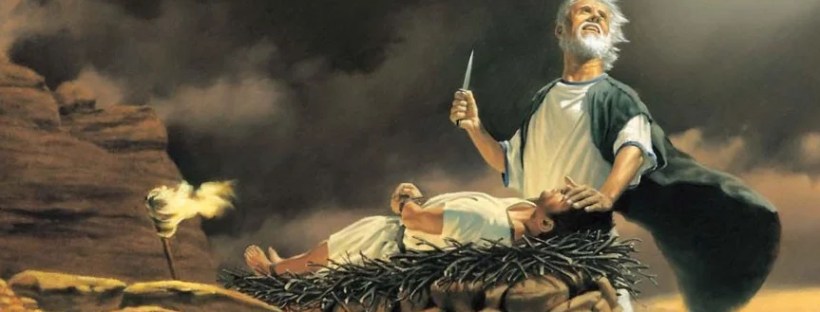
Probably the most controversial story in the entire Bible is God ordering Abraham to kill his firstborn son, Isaac. This story, recounted in Genesis 22, tells us that God commanded Abraham to offer Isaac as a burnt offering on a mountain of His choosing. When Abraham brought Isaac with him on the mountain, he bound Isaac to the table, but just as he raised the knife to kill him, the angel of the Lord called down and told Abraham to stop what he was doing. Abraham then notices a ram in the thickets and, recognizing it as God’s providence, offers the ram as a sacrifice on the altar instead of Isaac.
On the third day Abraham lifted up his eyes and saw the place from afar. Then Abraham said to his young men, “Stay here with the donkey; I and the boy will go over there and worship and come again to you.” And Abraham took the wood of the burnt offering and laid it on Isaac his son. And he took in his hand the fire and the knife. So they went both of them together. And Isaac said to his father Abraham, “My father!” And he said, “Here I am, my son.” He said, “Behold, the fire and the wood, but where is the lamb for a burnt offering?” Abraham said, “God will provide for himself the lamb for a burnt offering, my son.” So they went both of them together.
When they came to the place of which God had told him, Abraham built the altar there and laid the wood in order and bound Isaac his son and laid him on the altar, on top of the wood. Then Abraham reached out his hand and took the knife to slaughter his son. But the angel of the LORD called to him from heaven and said, “Abraham, Abraham!” And he said, “Here I am.” He said, “Do not lay your hand on the boy or do anything to him, for now I know that you fear God, seeing you have not withheld your son, your only son, from me.” And Abraham lifted up his eyes and looked, and behold, behind him was a ram, caught in a thicket by his horns. And Abraham went and took the ram and offered it up as a burnt offering instead of his son. So Abraham called the name of that place, “The LORD will provide”; as it is said to this day, “On the mount of the LORD it shall be provided.” – Genesis 22:4-14
Criticisms abound with this story and how it portrays God’s character, with some labelling it a “diabolical request” that puts a blameless victim in a horrific moral conflict. Others also argue that it paints Abraham in a horrible light as well, as a “morally insensitive servant” who was willing to kill his son without a second thought. Some biblical scholars also argue that this passage contradicts God’s later opposition to child sacrifice, as mentioned here.
I’d be lying if I said I didn’t understand the criticisms. Even though the story did end with God stopping Abraham from sacrificing Isaac, just the fact that He commanded Abraham to do it at all is something many people wrestle with, including millions of Christians. This isn’t something we as believers can just gloss over.
That being said, I also want to provide a different perspective than a lot of Christians have given in response to criticism levied against this story. Many have argued that this story demonstrates how we ought to put God above all else, even family. That our love for God should eclipse all else in our lives. While I certainly agree with that sentiment, and it’s definitely scriptural (Deuteronomy 6:5, Matthew 10:37, Matthew 19:29), I don’t think that’s the point of Genesis 22. In fact, I think it does more harm than good to look at the story that way.
Instead, we need to look at Genesis 22 in its full context – not just the context of the chapter itself (especially considering that “chapters” weren’t really in the minds of the authors who wrote the books of the Bible) but of Abrahams story leading up to this point. Abraham was promised the entire land of Canaan in Genesis 12:1-2:
“The Lord had said to Abram, “Go from your country, your people and your father’s household to the land I will show you.
“I will make you into a great nation,
and I will bless you;
I will make your name great,
and you will be a blessing.”
This promise is reiterated in Genesis 15:5, where God tells Abraham that his offspring will be as numerous as the stars in the sky, and “counts it as righteousness” when Abraham simply believes the promise despite his old age and lack of children. Of Isaac specifically, God says in Genesis 17:16 and 19 that he will be made into a great nation, whose lineage will include kings. And if Genesis 15:6 is anything to go by, Abraham surely believed this – after all, if he could believe BEFORE he became a father, it must have been much easier to believe after the fact!
Why am I pointing all of this out, though? Because it gives us a crucial bit of context that paints Abrahams actions in Genesis 22 in a new light. Context that is even provided millenia later, in Hebrews 11:18-19:
“God had said, “The descendants I promised you will be from Isaac.” Abraham believed that God could raise the dead, and really, it was as if Abraham got Isaac back from death.“
“It was as if Abraham got Isaac back from death.”
Abraham had enough faith to know that the same God that made a covenant with him to provide as many descendants as the stars in the sky, could bring his son back to life. And indeed, Abraham had no reason not to believe God would do this, since God told him that this promise would come through Isaac. Awfully hard for your lineage to include kings, if you’re dead before you have a son of your own!
Abraham understood this, and understood that even if God commanded him to kill Isaac, that he wouldn’t be separated from his son for too long. Abraham knew that one way or another, Isaacs death would be far from permanent, that God would deliver him from the clutches of death. That, in my humble opinion, is the test that Abraham had to pass by laying his son on the altar. It was never a question of, “You must be willing to kill your son to show that you love me more.” (Far be it from God to test anyone in such a way, especially since He explicitly forbids child sacrifice!) Rather, the test was, “Do you have enough faith to believe that I can raise your child from the dead? That everything I’ve promised you will come true, even if it looks like you will be preventing it?”
But more than that – this story is, as many stories in the Old Testament are, a type and shadow of Jesus Christ himself. Think about it? A father who willingly sacrifices his own son, knowing that his son will be raised from the dead? The only difference, of course, is that unlike with Abraham, God the Father did not spare Himself the pain of having his own Son taste death. If only temporarily. He intervened and provided a ram instead.
Conclusion
Genesis 22 is difficult to swallow for many people, believers included, and with good reason. It’s not an easy thing to read about sacrifice or even potential sacrifice of your own child to any god you may or may not believe in. But as I’ve said in my post Addressing Three Atheist Arguments, the focal point of the Christian religion is that death is not the end. It is not a roadblock to our life, merely a change of location, one that is not at all permanent from God the Father’s point of view. And with all that considered, I submit to you that this story does not, in fact, paint God as a monster.

