For those who don’t know, Alyssa Grenfell is a popular Youtuber who’s famous for her story of leaving the Mormon church. Much of her content is focused on critiquing LDS beliefs and practices, but occasionally she talks about how her worldview has changed and why she’s an atheist. I recommend you check out her channel. I think you’ll find her videos interesting, especially if you’re also an ex Mormon.
Today though I wanted to address her reasons for being an atheist, since these are arguments I often see levied against Christians in atheist vs theist discussions. I’ll outline them below:
- “Most people are the religion of their parents.”
This is one of the most popular arguments against Christianity, and religion in general. Basically the idea is that all or most religious people only believe what they do because their parents taught it to them, and not for intellectually pure reasons. But there are two problems with this position.
First of all, even if it was true that the majority of religious people are only believers because of their parents’ upbringing, that wouldn’t prove their religion false. In Alyssa’s case she’s raising her children in a secular household, but if they grew up to be atheist because of their upbringing that wouldn’t prove atheism false. For another example, there are plenty of people out there who can’t defend their belief in the theory of evolution. They only believe it because it’s what they were taught in schools, but it would be absurd to say that’s proof that evolution is false. It’s actually a subtle form of ad hominem: Ad hominem circumstantial, where you attack the personal circumstances of someone making an argument rather than directly addressing the argument itself.
For a Christian, you need to prove that Jesus didn’t rise from the dead to show why their religion is false. Simply saying, “You believe it because your parents taught you” isn’t an argument.
Second, the idea that if one religion were true everyone would convert to it ignores factors like cultural conditioning, personal biases, and free will. In Christianity’s case, the fact that everyone has not converted to it doesn’t prove that it isn’t true or even isn’t obviously true. Many people simply haven’t had the opportunity to hear the Gospel, in which case God will judge them fairly based on the limited knowledge they have. Or they don’t believe simply because they don’t want to. Of course I’m not saying people CAN’T have good reasons for not believing, but I would argue that Christianity’s truth is evident enough to those with an open mind. Particularly since every secular explanation for the resurrection of Jesus Christ falls apart on closer inspection. (Although that’s a post for another time.)
But more than that, I can flip this argument around: If there obviously was no God and religion was obviously nonsense, why does 80 percent of the human population believe?
- “If God is good, why is there evil in the world?”
Alyssa doesn’t use this exact phrasing, but her argument stems from this line of thinking. She uses the example of God supposedly saving a baby from dying while other babies die in poverty as proof that if there was a God, he’d be a horrible person.
To be fair, this is something a lot of believers wrestle with as well. The problem of evil has been a struggle for many people across many religions, and the unfairness of life is even addressed in Scripture (Psalm 73.) I don’t think you’ll find any serious Christian who denies this reality and hasn’t struggled with it. So I want to approach this topic with extra sensitivity.
That being said, this too can be countered by another question, one that C.S. Lewis articulates perfectly:
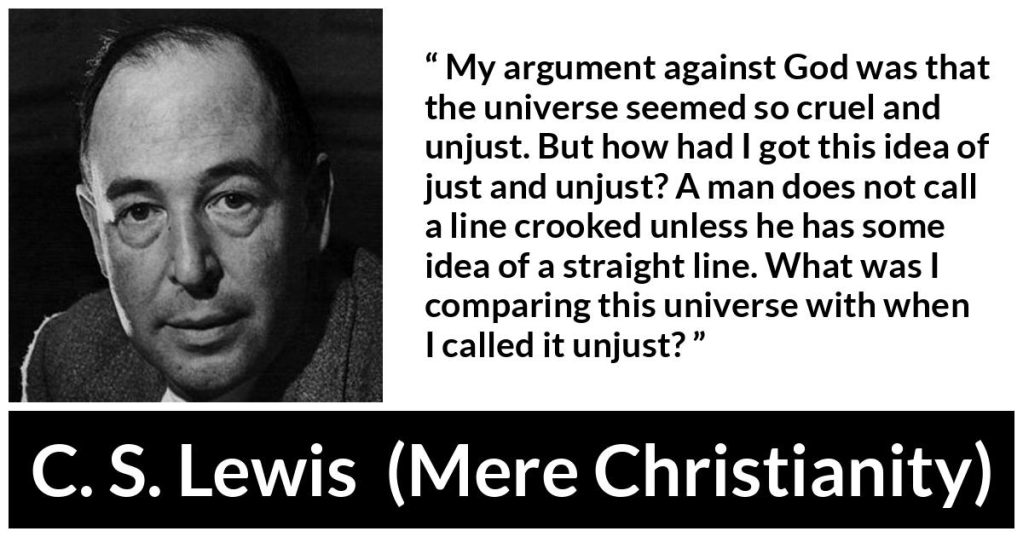
If there is no God, no transcendent value to anything, and what we call “good” or “evil” is just a chemical reaction in our brains shaped by millions of years of randomized, chaotic evolution…what real difference is there between a baby being saved and it dying? Someone asserting that the suffering we see in this world is consistent with a perfectly good God existing is no less objectively correct than Alyssa’s claim that it isn’t.
But even then, if Christianity is true, then death isn’t the end. We don’t “die”, per se, we just change locations. So even the baby who dies in poverty will experience the same eternal rest and consolation of the baby whose life was saved. Again I know this is a very sensitive topic and I don’t want to minimize the suffering of anyone who’s lost a child, but I’d ask that whoever poses this question at least seriously look at it through a theistic lens before dismissing religion as nonsense because of it.
- “There is no evidence for God.”
This is probably the most common argument you’ll hear from atheists. If you are a theist debating an atheist, nine times out of ten you’ll hear them say God doesn’t exist because there’s no evidence for it.
I don’t want to sound rude, but this is just a lazy assertion. The reason I say this is because whenever the point is made that there’s no evidence for God’s existence, there’s never a clear criteria given for what would qualify as evidence that God exists. Some people like CS Lewis converted because of the argument from morality. Others like Lee Strobel converted when they examined the historical evidence for Christs’ resurrection. Still others convert when they see the vast order and complexity of the universe, convinced that there’s a creative mind behind it. These people have a clear idea of what constitutes evidence that God exists, but if the atheist presenting this question can’t provide that, then there’s no discussion to be had.
Alyssa then argues that when her believer friends talk about miracles happening in their lives, there’s always a more logical explanation than God or the supernatural. I’m not sure what miraculous stories she’s heard, but from what I’ve seen, stage 4 cancer being healed after prayer, convincing even the secular doctor taking care of the patient that something supernatural is going on isn’t something that can be explained in a lot of other ways.
Conclusion
I don’t mean any offense to Alyssa in writing this post. Like I said I recommend you check out her channel, including her Youtube short that I linked above. The reason I’m responding to her arguments for atheism is because these are some of the most common arguments I hear atheists make, and I thought it was an easy opportunity for me to give my rebuttal to them.
I hope you enjoyed reading, and if you’re an atheist, that this post at least gave you something to think about.
 The Armchair Apologist
Do you, in fact, actually hear Atheists say that God doesn’t exist, or merely that they don’t believe your claims that one does?? I don’t. 😮
LikeLike
Yes, I do. In fact, I’ve heard them go beyond merely stating that God doesn’t exist and call it a delusion, comparing it to belief in Santa Claus or the tooth fairy. I’ve had people I consider friends insult my intelligence when they found out I was a theist.
To be fair, I’ve heard more fair minded atheists say its reasonable to believe even if they don’t share that belief. But I’ve seen plenty of atheists go beyond just that.
LikeLiked by 1 person
As a nearly life-long atheist, I will respect anyone’s belief system as long as they respect mine. I don’t go around promoting belief or non-belief, it’s just who I am. It doesn’t make me a bad person, nor does a strong belief in a Deity necessarily make the believer a good person; it cuts both ways.
Also, many people who are at heart just unpleasant and espouse religion with the clasped-hands and bowed head approach are more repulsive than someone who goes their own way, relgion notwithstanding.
LikeLiked by 1 person
Hello,
I don’t doubt that, and nothing in my post really disputes anything you said. Like I said I’ve known atheists who are very fair minded and don’t treat me like an idiot for my beliefs, and I offer them the same courtesy.
LikeLike
I grew up in the Methodist church and questioned everything from the first time I attended sunday school around 8 until the day I left the church in my early 20’s. I consider myself an atheist and wrote about it a few weeks ago where I explained why I was an atheist humanist. My life has revolved around science, and I have stubbornly looked for explanations for everything that I didn’t or couldn’t yet understand. I did this even when I was reading the bible in sunday school and youth groups making my pastors quite frustrated sometimes. I have personally not come across any tangible evidence to help me believe in something I can’t yet prove, it’s all theories in my experience. I don’t judge those that choose to believe in their religion or faith, but I do get frustrated with close-minded people that refuse to accept that other possibilities may exist. The “you’re going to hell if you don’t believe in God” or “but the bible says…” individuals throw at you the moment they realize I don’t have blind faith in what they believe in. I’m open minded and have studied multiple religions out of curiosity and keep coming back to atheism. This post was an eye opening read, and it helped me understand a bit more on how to approach the topic of religion with some people.
LikeLiked by 1 person
Thank you for your kind comment!
Yeah, the “you’re going to hell/the Bible says” crowd frustrates me too as a committed Christian. I’ve always been very technical minded and I try to understand what people on the opposing side of a debate would consider a rational argument before giving my two cents. I’m glad this post was an eye opener for you and that you can appreciate my perspective despite being an atheist. It’s always refreshing to get positive feedback from the other side.
LikeLiked by 1 person